Video Marketing Distribution: Where to Publish Business Videos

Updated: Apr 16

Creating a great video is only half the job. The other half, the part that actually determines whether that video does anything for your business, is distribution. Where your video lives, how it gets discovered, and which audiences it reaches are decisions that matter as much as anything that happens in production. A well-made video published in the wrong places or without a coherent distribution plan will underperform consistently, while a modestly produced video placed strategically in front of the right audience can generate results that far exceed its production budget.
Most businesses understand this in principle but struggle to act on it. The platform landscape for video is genuinely complex, and the temptation to simply upload content everywhere and hope for the best is understandable. The problem with that approach is that different platforms serve fundamentally different purposes in a distribution strategy, attract different audience behaviors, and reward different content formats. Publishing everywhere without a plan is not the same as having a strategy.
This blog breaks down the major video distribution platforms, how each one fits into a coherent video marketing distribution strategy, and how to make decisions about where to focus based on your specific business goals. By the end, the platform landscape should feel considerably less overwhelming and the path forward considerably clearer.
Why Distribution Strategy Comes Before Platform Selection
Before getting into specific platforms, the strategic logic that should govern all distribution decisions is worth establishing clearly.
Different videos serve different purposes in a business's relationship with its audience. Awareness-stage content is designed to reach people who don't know the brand yet. Consideration-stage content speaks to people who are already paying attention and evaluating whether to go further. Conversion-stage content addresses the specific questions and hesitations that stand between a warm prospect and a decision.
Each of these content types belongs in different places. Awareness content needs to be where new audiences can discover it. Consideration content needs to be where engaged audiences go to learn more. Conversion content needs to be where people are actively making decisions.
Distributing every video everywhere ignores these distinctions and typically produces mediocre results across the board. A strategic approach maps content type to platform purpose and builds a distribution plan that serves each stage of the audience relationship appropriately. This connects directly to what this blog on how businesses create effective video content strategy covers in depth: the decisions that precede distribution are what make distribution work.
The Major Distribution Channels and How They Actually Work
YouTube: The Evergreen Foundation
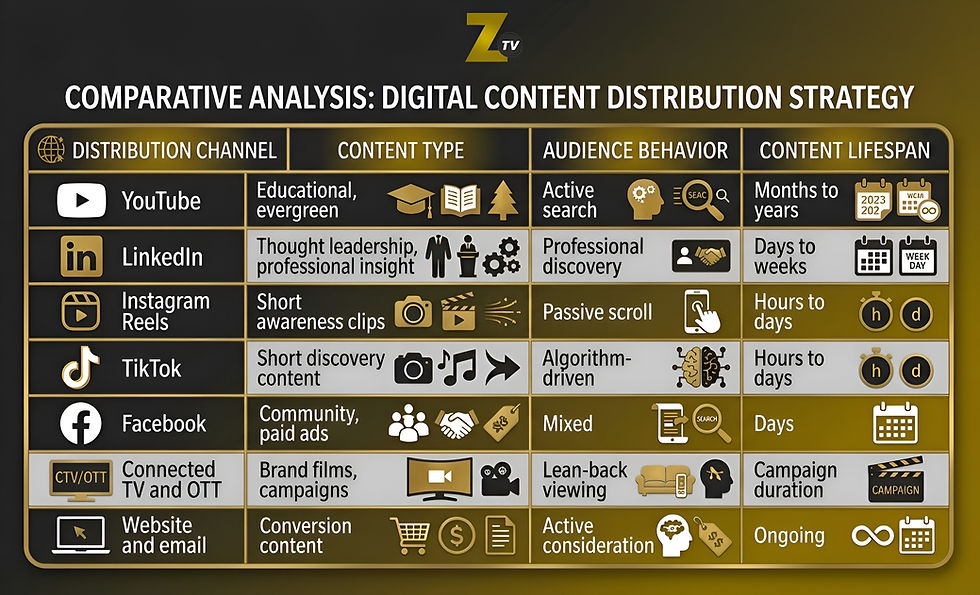
YouTube is the second largest search engine in the world and the platform with the strongest long-term distribution characteristics for business video content. Unlike social platforms where content has a lifespan measured in hours or days, a well-optimized YouTube video continues to be discovered through search for months and years after it's published.
For businesses whose target audience actively searches for information related to their products, services, or expertise, YouTube is the most important single distribution channel available. The investment in building a YouTube presence compounds in a way that social media content almost never does, because the library of searchable, indexed content grows in discoverability over time rather than decaying after the initial algorithmic push.
The content types that perform best on YouTube are educational, comprehensive, and genuinely useful. Tutorials, explainers, case studies, and deepdive commentary on topics relevant to the audience. Short, thin content rarely performs well here because the platform rewards watch time, and watch time requires content that earns it.
LinkedIn: The B2B Distribution Powerhouse
For businesses serving professional audiences, LinkedIn has become one of the most effective video distribution platforms available, particularly for thought leadership and expertise positioning content.
LinkedIn's native video receives significantly more reach than external links in most cases, which makes uploading directly to the platform rather than sharing YouTube links the right approach for content intended for LinkedIn audiences. The platform rewards professional insight, genuine perspective, and content that generates meaningful engagement in the form of comments and shares rather than passive consumption.
For anyone building a personal brand alongside a business brand, as covered in this guide on video marketing for personal branding and thought leadership, LinkedIn is often the primary platform where that authority-building work happens most efficiently in professional and B2B contexts.
Instagram and TikTok: Discovery and Awareness at Scale
These platforms operate on fundamentally different logic than YouTube or LinkedIn. Content lifespan is short. Discovery is algorithm-driven rather than search-driven. The content formats that work are brief, immediately engaging, and designed to earn attention in the first two to three seconds.
Instagram Reels and TikTok videos are awareness-stage tools first and foremost. They reach people who don't know your brand yet through algorithmic distribution that rewards engagement signals: completion rate, shares, saves, and comments. For building top-of-funnel awareness and growing an audience, they're genuinely powerful. For delivering the kind of substantive content that moves people through a consideration and decision process, they're limited by format constraints.
The strategic use of these platforms is to create short, high-value clips that introduce people to the brand and direct them toward longer-form content where a deeper relationship is built. Treating them as a funnel entry point rather than a complete distribution strategy is the right framing.
Facebook: Still Relevant for Specific Audiences
Facebook's organic reach for business content has declined significantly over the past several years, and it's rarely the primary distribution channel for most businesses starting video strategies today. However, it remains relevant in specific contexts: businesses serving older demographic audiences, paid video advertising campaigns, and Facebook Groups where highly engaged niche communities gather.
Facebook video ads in particular remain a cost-effective awareness and retargeting tool for businesses with the budget to support paid distribution. Organic Facebook video is harder to justify as a primary channel, but as part of a broader distribution approach, it adds incremental reach without requiring additional content creation if the material already exists for other platforms.
Connected TV and OTT Platforms: Premium Reach for Premium Brands
The connected TV and streaming landscape represents one of the most significant shifts in video marketing distribution that has occurred in the past five years. Audiences that were previously only reachable through traditional broadcast television are now accessible through targeted campaigns on streaming platforms, and the reach available through OTT platform providers has become genuinely viable for businesses well below the scale that broadcast TV advertising historically required.
For brands with the production quality and budget to execute well in this environment, connected TV distribution offers a combination of premium context and sophisticated targeting that no other channel matches. Viewers in leanback environments are more receptive to longer-form content and brand storytelling than audiences on mobile social platforms, making this the right channel for brand films, narrative campaigns, and content that benefits from the full-screen, high-attention viewing context.
Debrief:
Your Website and Email List: The Owned Channels That Get Overlooked
In the focus on social and search platforms, the distribution value of owned channels is consistently underestimated. Your website and email list are the only distribution infrastructure you fully control, and video performs exceptionally well in both contexts.
Video on landing pages and product or service pages directly influences conversion rates. A well-placed explainer or testimonial video on a page where people are making decisions does conversion work that no social platform can replicate because the viewer is already in an active consideration mindset rather than a passive scrolling one.
Email campaigns that feature video thumbnails with play buttons generate measurably higher click-through rates than text-only emails, and the subscribers receiving those emails are the warmest audience a business has. Treating owned channels as distribution infrastructure rather than afterthoughts often produces the highest return on video investment of any channel in the mix.
Repurposing as a Distribution Multiplier
A video content strategy that produces one version of each piece of content for one platform is leaving significant distribution value on the table. The most efficient video marketing distribution approaches treat the original production as source material from which multiple platform-appropriate versions are derived.
A long-form YouTube video becomes three to five short clips for Instagram and TikTok. The audio becomes a podcast episode. The key insights become a LinkedIn post with a native video clip attached. The transcript becomes a blog post. A pull quote becomes a graphic for static social posts.
Working with content creator monetization that understands this repurposing logic from the beginning of a production means the source material is captured in ways that serve downstream formats effectively, rather than requiring awkward adaptation of content that wasn't designed with repurposing in mind.
For a foundational understanding of why video outperforms other content formats across all these channels, this blog on why video marketing is essential for brands covers the core mechanisms that make video distribution investments worth making in the first place.
Building a Distribution Plan That Matches Your Resources
The video promotion strategy that works is the one that's realistic about what a business can actually sustain. An ambitious distribution plan across six platforms that burns out in three months delivers less long-term value than a focused strategy across two or three channels executed consistently over two years.
The practical starting point for most businesses is selecting one primary platform based on where their target audience most actively spends time, building a consistent presence there, and adding secondary distribution to one or two supporting channels as the production capacity allows. That focus produces better results than dispersion across channels that can't all be served well simultaneously.
Content distribution platform decisions should also account for where the business's specific audience actually is, not just where audience sizes are largest in aggregate. A B2B software company and a consumer beauty brand have almost entirely different optimal distribution mixes despite both using video as a primary content format.
We work with businesses to build video distribution strategies that are both ambitious and achievable, matching the right platforms to the right content types and the right audience behaviors to produce results that compound over time rather than spike once and disappear.
FAQs
What is video marketing distribution, and why does it matter?
Video marketing distribution is the strategy of deciding where, how, and to whom your video content gets published and promoted. It matters because production quality alone doesn't determine results. The same video placed strategically in front of the right audience on the right platform will dramatically outperform the identical video published without a coherent distribution plan. Distribution is what converts production investment into business outcomes.
Which platform is best for publishing business videos?
There's no single best platform because different platforms serve different purposes. YouTube is best for long-term, searchable content that builds discoverability over time. LinkedIn is best for B2B and professional audience content. Instagram and TikTok are best for short awareness-stage content reaching new audiences. Connected TV and OTT platforms are best for premium brand storytelling. The right answer depends on the audience, the content type, and the business goal the video is designed to serve.
How do you distribute videos on a limited budget?
Start with owned channels: your website, email list, and a single social platform where your audience is most active. These cost nothing beyond production and deliver a reliable reach to the most engaged audience you have. Repurpose content across formats to maximize the value of each production. Add paid distribution selectively for validated content that already performs well organically, rather than boosting every video indiscriminately.
Should you upload videos natively to each platform or share links?
For most social platforms, native upload significantly outperforms sharing links from other platforms. LinkedIn, Instagram, TikTok, and Facebook all prioritize native video in their algorithms and restrict the reach of external links. YouTube is the exception where sharing the YouTube link makes sense on other platforms because you want to drive views and watch time back to your channel. Building platform-specific versions of content for native upload produces better distribution results than crossposting a single version everywhere.
How often should a business publish video content across distribution channels?
Consistency matters more than frequency. Publishing one high-quality video per week consistently for a year produces more compounding distribution value than publishing daily for two months and then stopping. The right cadence is whatever can be sustained at a quality level that reflects well on the brand. For most small to mid-sized businesses, one to two videos per week across their primary channels is a realistic and effective baseline that can be built on as production processes become more efficient.


Comments