Streaming TV Advertising Benefits: Why Businesses Are Shifting to Streaming TV Advertising


Something has been happening quietly in advertising budgets for the last few years, and it's reached the point where it's no longer subtle. Businesses that used to put real money into traditional broadcast television are moving toward streaming. Not a little bit. Significantly.
And the ones doing it aren't doing it because streaming feels modern or because someone at a conference told them to. They're doing it because the results are better and the math finally makes sense in a way it didn't before.
Traditional TV advertising was built on a model that made perfect sense when the alternatives were limited. You pay for broad reach, you accept that a meaningful portion of that reach isn't your customer, and you trust that the volume justifies the waste. When everyone was watching the same handful of channels, being on those channels was genuinely valuable, even with all the inefficiency attached to it.
But the audience moved. And when the audience moves, the advertising has to follow, or it's paying for attention that isn't there anymore.
The streaming TV advertising benefits available to businesses today aren't just incremental improvements on the old model. In some ways, they're a fundamentally different proposition. Better targeting. Real measurement. Premium viewing environments. Entry points that don't require a national brand budget.
Understanding what's actually changed helps explain why this shift keeps accelerating.
The Audience Is Already There
Before getting into the specific advantages, it's worth being clear about where viewership actually lives right now because the numbers tend to surprise people who haven't looked recently.
Streaming viewership has overtaken traditional broadcast and cable television in total hours watched. That crossover happened faster than most industry forecasts anticipated, and it hasn't plateaued.
Connected TV devices, meaning smart TVs, streaming sticks, and game consoles used as media players, are in the majority of households. People are watching premium content through streaming platforms on their living room televisions, not just on phones during a commute.
The living room screen that traditional television advertising owned for decades is now streaming territory. The audience advertisers want to reach is watching streaming content. That's not a projection anymore. It's where things already are.
Targeting That Traditional TV Never Came Close To
If there's one streaming TV advertising benefit that changes the conversation most completely for businesses that have tried traditional television and come away frustrated, it's targeting.
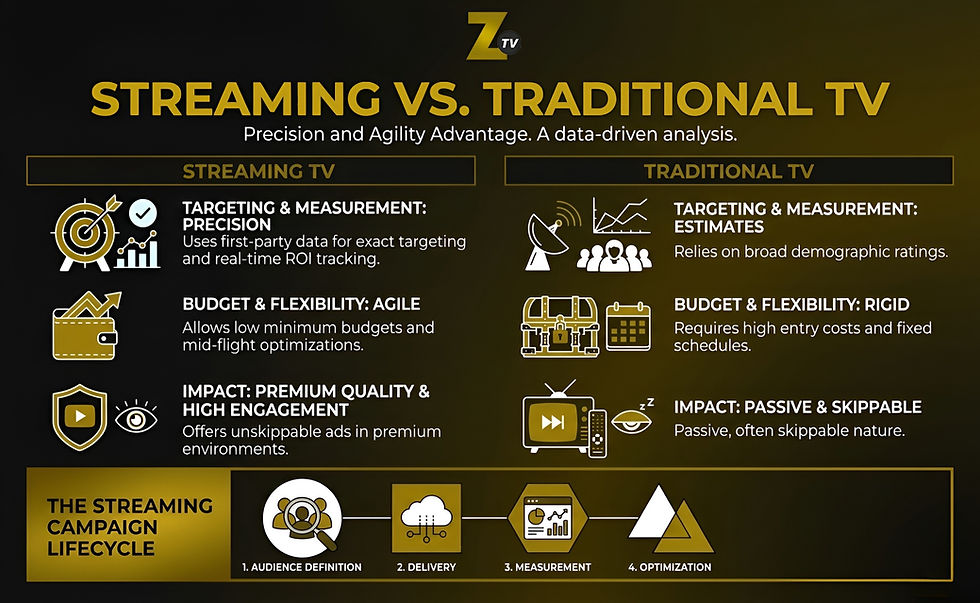
Traditional TV targeting is genuinely blunt. You buy a time slot on a channel with a particular demographic profile, and you reach whoever happens to be watching at that moment. Some of those people are your customers. A lot of them aren't. You pay for all of them equally, and there's no mechanism to change that.
OTT advertising benefits significantly from the ability to be far more precise about who actually sees your message. Streaming platforms have data on their viewers that broadcast television never had access to. Viewing behavior, household demographics, geographic location, content preferences, and device type.
This data lets advertisers serve their message to viewers who match specific audience profiles rather than broadcasting broadly and hoping enough relevant people are in the mix.
For a local business that only serves customers within a specific radius, this precision is genuinely transformative. For a business selling to a defined demographic, it removes the waste that made traditional TV advertising cost-prohibitive for anything below a major national brand.
The connected TV advertising benefits around targeting have opened television advertising to businesses that couldn't have considered it seriously under the old broadcast model.
Measurement That Actually Tells You Something
Ask someone who ran a traditional TV campaign how many people watched their ad, and you'll get an estimate. A good estimate based on panel data and statistical modeling, but an estimate nonetheless.
Ask someone running a streaming campaign the same question, and you'll get actual numbers.
Streaming ads' advantages in measurement represent a real shift in what advertisers can actually know about their campaigns. Impressions served. Video completion rates. Clickthrough rates on interactive formats. Attribution data connecting ad exposure to real downstream actions.
These aren't approximations built from sample panels. They're actual data from actual viewing sessions.
This matters enormously for any business trying to make intelligent decisions about where advertising money should go. You can see what's working in real time. You can see what isn't. You can make adjustments during a campaign rather than waiting until it's over to find out it didn't deliver.
The optimization capability that digital advertisers have had for years in search and social is now available in the premium video environment that streaming represents.
Comparison 1: Reach
The Environment Matters More Than People Give It Credit For
Where an ad runs affects how it's received, this is true in print, it's true online, and it's absolutely true in video.
Traditional TV advertising benefited from appearing within premium content. An ad during a popular show carried some of the credibility and attention of that show by proximity. Digital display advertising largely lost that association when it moved onto pages cluttered with competing content, other ads, and navigation that pulled attention in multiple directions simultaneously.
Streaming advertising recovers something that a lot of digital advertising gave up. Ads that run within premium streaming content appear in a high-attention, genuinely low-distraction environment. Viewers choose what they're watching. They settled in intentionally. They're often on a large screen with fewer competing stimuli than a typical browsing session involves.
The streaming ads' advantages in terms of context and attention quality show up consistently in brand recall data and viewer response metrics. An ad watched in that environment lands differently than the same ad appearing as a pre-roll on a platform where skipping is the primary instinct.
Television Advertising Isn't Just for Big Brands Anymore
This is probably the most practically significant change in the streaming advertising landscape, and it's still underappreciated by a lot of small and mid-sized business owners.
Traditional broadcast TV was effectively closed to smaller businesses. Production costs were substantial before you even got to airtime. The broad, untargeted reach meant cost per relevant viewer was difficult to justify without a massive overall budget to absorb the waste. Television advertising was something national brands did. Everyone else watched from the sidelines.
Streaming has changed both sides of that equation in real and meaningful ways. Production formats have become more flexible and accessible. Connected TV advertising benefits from efficient targeting mean a smaller budget reaches a higher proportion of relevant viewers rather than being spread thin across a general population.
A business that couldn't have seriously considered television advertising a few years ago can run a legitimate streaming campaign today, measure the results with actual data, and make decisions based on what that data shows.
That democratization of television advertising is one of the more significant shifts in the marketing landscape in recent years. The businesses that recognize it early have an advantage over competitors still operating on the assumption that TV advertising isn't for businesses their size.
How Viewers Watch Streaming Is Different, Too
There's a behavioral dimension to streaming advertising that doesn't come up often enough in conversations about OTT advertising benefits, and it's worth understanding.
People watching streaming content are there intentionally. They chose what to watch, they found it, they pressed play, and they settled in. That level of intent is different from the passive background viewing that characterizes a significant portion of traditional broadcast watching.
The television on in the room while someone does other things is a different advertising environment than someone actively engaged with a show they chose to watch.
Ad-supported streaming tiers have grown substantially as a proportion of total streaming viewership, and they place ads in front of engaged, intentional viewers in a context where ad loads are generally lower than traditional TV.
Fewer ads per hour means each one gets more attention and sits in a less cluttered environment. Completion rates for streaming ads consistently reflect this. Viewers in a streaming context are there to watch, and they watch accordingly.
Comparison 2: Streaming TV Might Be A Better Choice

Television advertising used to mean a big budget, a lot of waste, and results you mostly had to take on faith. Streaming changed all three of those things. The targeting is real, the measurement is real, and the audience is genuinely there. That's the environment the TV advertising agency operates in every day, and it's why businesses that discover what streaming advertising can actually do rarely find a reason to go back.
FAQs
What are the main benefits of streaming TV advertising?
The main streaming TV advertising benefits are precise audience targeting, accurate and real-time campaign measurement, access to premium viewing environments, and budget entry points that smaller businesses can actually work with.
Together, these advantages mean businesses can reach the right viewers, know whether the campaign is delivering, and make adjustments based on real data rather than estimates and projections.
How is OTT advertising different from traditional TV advertising?
OTT advertising runs through internet-connected streaming platforms rather than over broadcast or cable signals. The practical differences are significant. OTT advertising benefits include the ability to target specific audience profiles rather than broad demographics, measure actual campaign performance rather than estimated reach, and run campaigns at budget levels that traditional broadcast television never made accessible to smaller businesses.
Is streaming advertising worth it for small businesses?
Yes, genuinely, and this is one of the more meaningful changes the streaming landscape has created. Connected TV advertising benefits from precise targeting mean smaller budgets reach a higher proportion of relevant viewers rather than being diluted across general audiences.
Businesses that couldn't have justified traditional TV advertising can now run legitimate streaming campaigns, measure the results accurately, and make intelligent decisions about what's working.
How do you measure the success of a streaming TV campaign?
Streaming campaigns generate actual data rather than panel-based estimates. Impressions served, video completion rates, clickthrough rates on interactive formats, and attribution data connecting ad exposure to downstream actions are all measurable in real time.
This measurement capability is one of the core streaming ads advantages over traditional television, and it enables real optimization during a campaign rather than only post-campaign reflection on what might have worked.
What targeting options are available with connected TV advertising?
Connected TV advertising can be targeted based on viewing behavior, household demographics, geographic location down to zip code level, device type, and content preferences. This level of precision means advertisers serve their message to viewers who match specific audience profiles rather than buying broad demographic time slots and accepting the inefficiency that comes with them.
For local and regional businesses, especially, the geographic targeting capability alone changes what television advertising can realistically accomplish.


Comments