OTT Advertising ROI: Measuring the Success of OTT Advertising Campaigns
- Be on ZTV

- Apr 3
- 7 min read

Television advertising used to be a leap of faith. You bought airtime, ran your spot, and hoped the right people were watching. Attribution was rough, audience data was thin, and proving ROI often meant waiting weeks for brand lift surveys that told you something you half-suspected anyway. Then streaming arrived and rewrote the rules.
OTT advertising changed what's measurable in a fundamental way. Brands can now track who saw an ad, on what device, at what time, and whether that viewer did anything afterward. That kind of visibility didn't exist in the linear TV era. But more data doesn't automatically mean more clarity. Many businesses running OTT campaigns are still drowning in metrics without a clear sense of what's actually working or why.
This blog is here to fix that. Whether you're newer to streaming or looking to sharpen how you measure results, what follows is a practical breakdown of OTT advertising ROI: what it means, how to track it, and what to actually do with the numbers.
Not sure if your current measurement approach is telling the full story? Keep reading.
What Makes OTT Different from Every Other Ad Channel
To measure OTT well, you first need to understand why it behaves differently. OTT, short for over-the-top, refers to video content streamed via the internet rather than delivered through cable or broadcast. Hulu, Peacock, Tubi, Pluto TV, and hundreds of other streaming services all fall under this umbrella. Ads on these platforms reach people across smart TVs, streaming devices, gaming consoles, phones, and laptops.
This guide on what OTT advertising is covers the mechanics in more depth, but the core point is this: OTT combines the emotional weight of TV-style creative with the targeting precision and trackability of digital. That's a genuinely powerful combination. It also means ROI doesn't behave the way it does in search or social.
Someone sees your ad on their living room TV, thinks nothing of it, then searches your brand name three days later. LastClick attribution marks that as organic. The OTT campaign gets no credit. This is the central challenge, and it's why measuring connected TV ad performance requires a different mental model than most digital channels.
The Metrics Worth Paying Attention To
Platforms will surface with plenty of numbers. Not all of them matter equally.
Completion rate is one of the most honest upper-funnel signals available. OTT ads are usually non-skippable, so completions are naturally high, but meaningful drops before the end still signal something: creative fatigue, wrong audience, or a disconnect between the ad and the content it's running alongside. Anything below 85% warrants a look.
View-through rate is the bridge between exposure and behavior. It tracks how often someone who saw your ad later visited your site or completed a defined action within a set window. This is arguably the most important metric for calculating true OTT advertising ROI because it connects the viewing moment to downstream activity.
Reach and frequency matter more in streaming than people often realize. Because OTT allows tight audience targeting, smaller audience pools get saturated quickly. Seeing the same ad five times in one evening is a real thing, and it erodes both brand sentiment and campaign efficiency. Frequency capping is essential.
Brand lift measures the stuff that's harder to quantify but genuinely important: awareness, recall, purchase intent. It typically involves serving surveys to exposed versus unexposed audiences and comparing responses. For campaigns built around brand building rather than immediate conversion, this is the clearest signal you have.
Cost per completed view normalizes your spend against actual engaged impressions. Paired with conversion data, it gives you a more honest efficiency benchmark than raw CPM.
Attribution: Where Most Measurement Falls Apart
This is the part that trips people up. Attribution in OTT is genuinely complicated, and pretending otherwise doesn't help anyone.
The two main approaches are deterministic and probabilistic matching. Deterministic attribution follows logged-in users across devices, connecting an ad exposure on a smart TV to a purchase made later on a laptop with high confidence. Probabilistic attribution uses modeled signals, IP addresses, device graphs, and behavioral patterns to infer those connections when direct identifiers aren't available.
For businesses working with a TV advertising agency or managing buys in-house, understanding which model your platform uses is not a minor detail. Deterministic data is more precise but covers fewer users. Probabilistic models reach further but introduce more uncertainty into the numbers. Most sophisticated OTT campaigns use both, layered together.
Cross-device behavior is where a lot of attribution gets lost. The viewing happens on a TV. The conversion happens on the phone two days later. Without a proper tracking infrastructure, that conversion looks organic. This is exactly what OTT marketing analytics platforms are built to solve, stitching together the customer journey across screens and time gaps.
Building a Measurement Framework That Actually Works
There's a difference between having access to data and having a system that makes data useful.
Here's a practical structure:
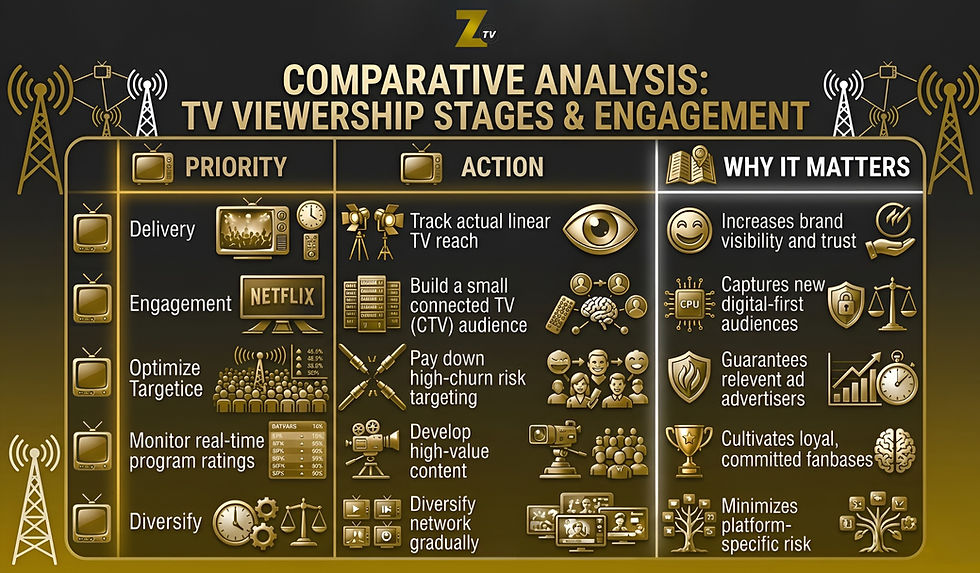
The goal is connecting these layers into a coherent story. Delivery data confirms the campaign ran. Engagement and brand metrics confirm it landed. Business outcome data confirms it worked. Campaigns that stop at delivery metrics are telling maybe a third of the story.
For brands just starting out with streaming measurement, pixel-based viewthrough tracking with a defined conversion window, typically seven to fourteen days postexposure, is the most accessible entry point. It's not perfect, but it's a meaningful start.
Platform Choice Affects What You Can Measure
This doesn't get discussed enough. Where you run your OTT campaigns has a direct effect on how well you can measure them.
Walled garden platforms like Hulu keep most audience and performance data proprietary. You get solid campaign-level reporting within their system, but integrating that data with your own CRM or third-party attribution tools is limited. Open programmatic OTT, bought through demandside platforms, typically offers more data portability and integration flexibility, which matters a lot if you're trying to build a crosschannel view of performance.
When evaluating OTT platform providers, measurement capabilities and data export options deserve as much attention as reach and pricing. A platform with great targeting but a black box around attribution creates real blind spots in your ROI picture.
Creative quality is equally relevant here. Partnering with strong video production services isn't just about aesthetics. It directly affects completion rates, brand recall scores, and downstream conversion efficiency. A poorly produced ad running on a perfectly targeted buy will still underperform. Production and media strategy aren't separate decisions when you're thinking seriously about ROI.
What OTT Advertising Costs and What That Means for Benchmarks
Cost context matters when you're interpreting ROI. OTT generally operates on a CPM model, with rates shifting based on targeting depth, platform, audience quality, and format. Broad reach campaigns on free ad-supported streaming platforms might run $10 to $25 CPM. Tighter audience targeting on premium inventory can push $40 to $60 or beyond.
This blog on OTT advertising costs walks through the pricing landscape in more detail for businesses mapping out their media budget. The key thing to remember is that CPM is a cost input, not a performance output. A $15 CPM reaching an audience that never converts will always lose to a $45 CPM reaching people with genuine purchase intent.
True ROI calculation is conceptually simple: revenue attributable to the campaign divided by total spend, including production costs. The difficulty is always in the attribution, specifically making sure the revenue figure actually accounts for view-through conversions and cross-device activity rather than only the direct clicks that happen to be easiest to track.
Why Targeting Precision Improves Every Downstream Metric
No measurement framework rescues a campaign aimed at the wrong people. Targeting in OTT has expanded well beyond basic demographics. Behavioral data, purchase intent signals, geographic precision down to zip code level, contextual targeting by content category, first-party audience matching from your CRM: all of these are available, and all of them matter.
This guide on OTT advertising targeting explores how businesses use these layers strategically. The practical impact is measurable: better targeting means higher completion rates, stronger brand recall, better view-through conversion, and lower cost per acquisition. Every metric in your framework improves when the right people are seeing your message in the right context.
Retargeting within OTT is also increasingly viable. Viewers who've previously visited your site or engaged with earlier campaigns can be served streaming ads as a mid-funnel touchpoint. This kind of multiexposure approach tends to drive meaningfully stronger ROI than top-of-funnel exposure alone, largely because the audience already has some familiarity with the brand before the ad runs.
What Good Measurement Actually Looks Like
OTT has made television advertising accountable in ways that weren't possible before. But accountability requires intention. The brands seeing the strongest returns aren't just running campaigns and waiting to see what happens. They're building measurement frameworks before launch, defining what success looks like, and connecting every metric back to actual business outcomes.
Content creator monetization works alongside brands at every stage of this, from creative development through attribution strategy and ongoing campaign optimization. The goal is always campaigns that can be proven to work, not just assumed to.
The guesswork era of TV advertising is over. The brands that figure out measurement now will have a real edge over the ones still treating streaming like a billboard.
FAQs
How is OTT advertising ROI calculated?
OTT advertising ROI is calculated by dividing the revenue attributed to a campaign by total spend, including creative costs, and expressing it as a ratio or percentage. The real complexity lies in attribution: accurately connecting ad exposures to conversions using view-through tracking, pixel data, and crossdevice modeling. Getting attribution right is what separates meaningful ROI figures from rough estimates.
What streaming TV ad metrics should I prioritize?
Completion rate, viewthrough rate, reach and frequency, brand lift, and cost per completed view are the most meaningful signals for most campaigns. For performance-focused campaigns, downstream metrics like attributed site visits and cost per acquisition tell you the most about actual business impact. Platformreported impressions alone are rarely enough.
How does connected TV ad performance compare to traditional TV advertising?
Connected TV offers far more measurement precision than traditional linear TV. CTV allows impression-level tracking, cross-device attribution, and direct connection to website and conversion activity. Traditional TV relies on panelbased ratings and surveydriven lift studies with slower feedback loops and broader uncertainty ranges. For brands that care about proving ROI, CTV has a significant structural advantage.
What attribution model works best for OTT?
Most practitioners recommend a hybrid approach: deterministic attribution for logged-in users where devicelevel matching is possible, layered with probabilistic modeling to extend coverage across audiences where direct identifiers aren't available. Neither method alone is sufficient. Used together, they provide the most complete and accurate picture of campaign-driven behavior.
How long should you run an OTT campaign before evaluating ROI?
For brand-focused campaigns, four to eight weeks is the general minimum before drawing meaningful conclusions, since brand lift metrics need sufficient exposure to show measurable movement. Performance campaigns focused on direct conversions can yield useful early signals after two to four weeks of consistent delivery, particularly with view-through attribution windows of seven to fourteen days.


Comments